



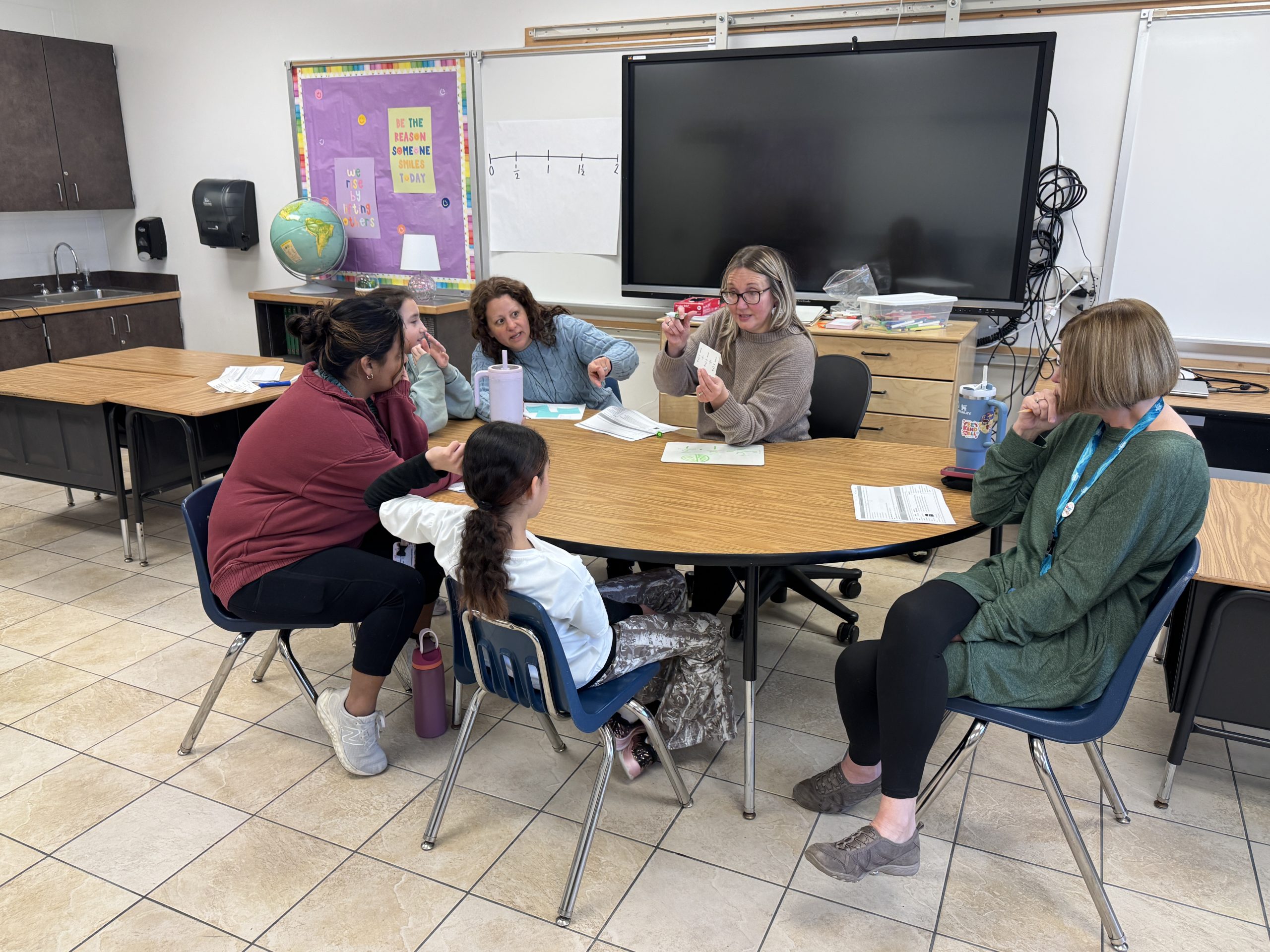
Windsor Oaks Elementary students regularly join teacher collaboration during immersive math and reading lessons.
This innovative approach gives teachers real-time insight into student thinking, allowing educators to catch misconceptions as they happen and respond immediately.
Even better — students and teachers are loving the experience.
Math specialist Madeline Isacoff and other teachers collaborated while teaching fourth graders how to add and subtract fractions.
In a portion of the math curriculum titled “Whole Group Warm Up,” teachers display a card with a fraction addition problem on it (Example: ½ + ½ ).
The teacher then shares several statements about the problem, and students use thumbs up or thumbs down to indicate if they agree or disagree with the statement. (Example: The sum is greater than 1/2. The sum is greater than 1. The sum is less than 1/2.)
“This activity provides the foundation for estimating sums and differences, while also encouraging the students to share their own strategies for fraction computation,” Isacoff said.
The group then engaged in the “Simplifying Fractions” lesson.
“Students had struggled with this concept, so we were intentional in selecting it for our Immersive Learning Experience,” said Isacoff.
During the collaborative session, Alyson Szykuc, coordinator of special education for the Department of Programs for Exceptional Children, demonstrated how specially designed instruction can be delivered alongside the general education lesson.
“Bringing teachers and students into the same modeled lesson creates an authentic space for collaboration, reflection and purposeful planning,” Isacoff said. “It allows teachers to truly experience the curriculum as learners while thoughtfully preparing to meet the needs of every student.”
Fourth grade teacher Lisa McCabe said collaboration gives her direct insight into how students think through complex skills like converting measurements and comparing fractions to benchmarks.
“Hearing their reasoning helps us better understand where misconceptions happen and what strategies truly support their learning,” McCabe said. “It also empowers students to take an active role in shaping instruction, making learning more meaningful and effective.”
Teacher Alexandria Rodriguez participated in immersive learning experiences in measurement and one in simplifying fractions.
“The value of having students in collaboration was that it created an opportunity for shared learning between the student and the teacher,” she said. “As a new fourth grade teacher, having that different perspective is extremely valuable and helps me better myself as a teacher.”
“I was able to see the student’s thinking in real time from an outside perspective, which was helpful — knowing I would be teaching this topic in our upcoming unit. The things I liked most about that opportunity were being able to observe a different teaching perspective on introducing a topic, while also identifying student misconceptions in real time through collaboration.”